Bats vs Birds

As if birds didn’t already have enough problems in this world, now it turns out that there is a large European bat (up to 18 inch wingspan) that catches and eats migrating birds on the wing.  By attaching biologging tags to 14 greater noctule bats in Spain and recording the variability of the bats’ echolocation buzzing and the altitudes where they were foraging, researchers were able to determine that the bats mostly pursued and ate insects at lower altitudes under about 300 ft.  But on two occasions, tagged bats were recorded flying up to nearly 4000 ft. where the intense buzzing of their echo locations showed prey pursuit.  In one case, the pursuit was short as the prey apparently escaped.  In the other case, the bat followed its prey (identified by vocalizations as a European robin) down close to the ground, captured, killed, and ate it (masticating sounds were recorded for 23 minutes)—all while still on the wing!  

A few wings of other birds were found on the ground below the greater noctule bats’ hunting grounds, but this bat is rare and it is not known what impact their bird hunting capabilities might have on migrating European songbirds.

Based on an article in Science, 9 October 2025

Birds and Solar Eclipse

Next time you have a chance to view a total solar eclipse, watch and listen to what the birds around you are doing!  That is what several researchers in Indiana did in April of 2024 when the path of a total solar eclipse passed across their area during the period when vocalizations relating to territorial establishment and mate attraction are leading up to breeding season. They set up microphones to record bird vocalizations the day before, the day of, and the day after the eclipse for a period each day centering on the time of totality. But that isn’t all they did. In an excellent example of encouraging active public engagement in science (“citizen or participatory science”), they created a smartphone app that allowed users to record observed behaviors (such as singing, flying, eating) and they recruited observers not only in the path of totality from Mexico to Maine, but elsewhere across the continent.  Extensive statistical and AI analysis of thousands of observations showed that the behavior of 29 of 52 species was significantly affected by the brief darkness, but with considerable variation.  Nineteen species produced a “dawn chorus” as light returned (notably American robins and a barred owl), fewer species (11) responded with a dusk chorus as daylight dimmed, and during totality 6 of 12 species increased vocalizations and 6 decreased.   Movement dropped noticeably during totality. 

This natural experiment shows that the biological rhythms of most birds are indeed affected by light/dark cycles—even when “night” lasts for just 4 minutes—and that citizen science can be a powerful tool for understanding the natural world.

Based on an article in Science, 9 October 2025

Evolution in Our Time

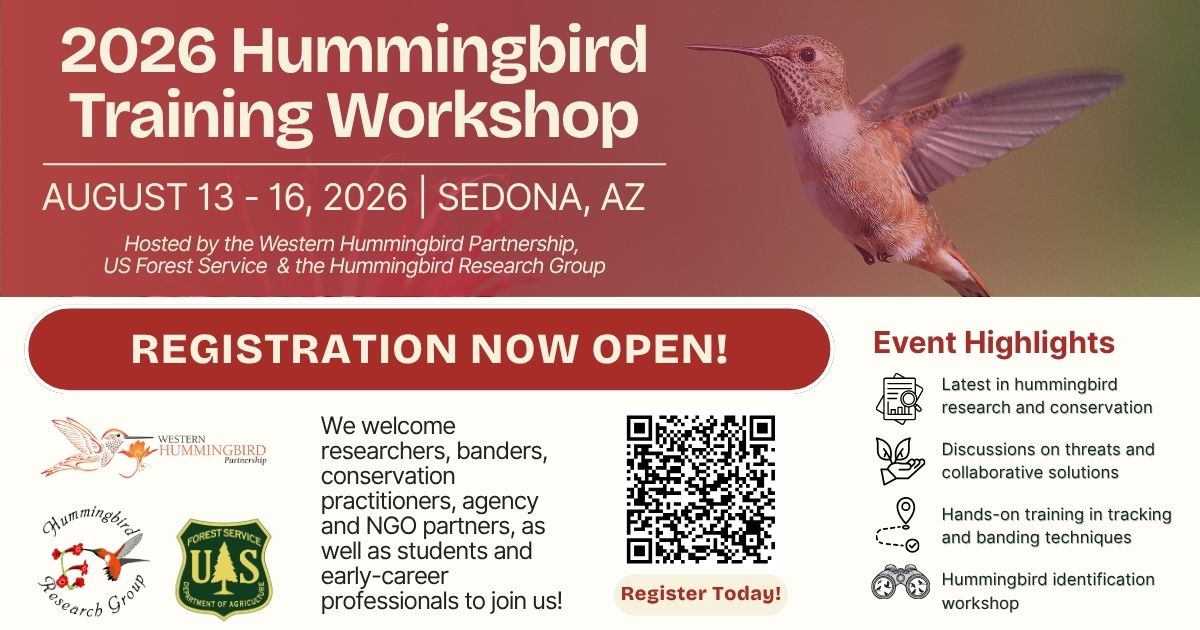
People in the US have been feeding hummingbirds for at least a century but the pastime really took off after WWII when commercially-made feeders became available.  Curious about a range expansion of Anna’s hummingbirds northward in California, Nicolas Alexandre, then a graduate student at the University of California Berkeley, turned to Audubon Christmas Bird Counts from 1938 to 2019 to document the Annas’ movement north. The research team also looked at US Census records to show human population density and looked at newspaper ads for feeders as a proxy for feeder density.  Analysis of museum specimens quantified changes in Anna’s hummingbird beaks over time and found that beaks got longer and larger as feeders proliferated–a noticeable difference in a surprisingly short time span. 

But science is never simple and straightforward.  In California, the widespread planting of non-native eucalyptus trees, which provide nectar throughout the year, likely also contributed to the range expansion of Anna’s hummingbirds.   In colder regions north of the species’ historical range, beaks became smaller and shorter, which seems counter to the trend of larger bills.  But it turns out hummers use their beak to dissipate heat and a smaller beak with less surface area would help conserve heat in colder areas.  Another interesting finding—where feeders were very dense, male hummingbirds also developed pointier and sharper beaks.  Anybody who has watched hummers at feeders can relate to how some are very aggressive in defending a food source and understand that a sharper bill might help intimidate other hungry hummers.

–Based on an article in Science, 29 May 2025

Spring 2026 Birding Competition

The Sangre de Cristo Audubon Society encourages members to get out and enjoy the spring migration in celebration of World Migratory Bird Day on May 9. As a bonus, you can raise funds for your favorite environmental group with a little friendly competition.
Between May 8 and May 17, choose any 24-hour period to count as many bird species as you can in any area north of Interstate 40. You can bird solo, but teaming up with a friend or two is encouraged.
The individual or team that records the greatest number of species will earn a donation, made in their name by Sangre de Cristo Audubon, to the named environmental organization of their choice.
Prizes
1st place: $750 donation
2nd place: $350 donation
3rd place: $250 donation
This is our first event of this sort, and we hope it will inspire a good start for our spring birding season.
How to submit results
By May 18, please email the following information:
·       Your name and your teammates names
·       Birding location(s)
·       Total number of species observed
·       The date and 24-hour period of your count
·       The environmental organization you would like to support
Please send submissions to Shane Woolbright at mesoinc@hotmail.com and include a cell phone number. We’ll announce the results on our website the following week.

Dark Sky Week

What is a dark sky worth? It is priceless, some would say. Think about it this month during International Dark Sky Week, April 13-20, 2026.

Light pollution threatens dark starry skies all around the world. Not limited to major urbanized areas, excess artificial light at night disrupts life cycles of nocturnal animals and interferes with sleep of diurnal ones, including humans. It can disrupt with bird migration by distracting and confusing nocturnal migrants’ orientation and inducing window collisions. And it takes away the wonder and cultural heritage of a sky full of constellations and the luminous band of the Milky Way.

Audubon is a partner of Dark Sky International in their efforts to reduce light pollution. Beginning in 1956, Audubon persuaded the Empire State Building to turn off lights during migration seasons. More recently, Lights Out campaigns in cities around North America have saved birds and raised awareness about our over-lit nighttime environment.

Among local events planned for this week is a webinar presentation by Jeff Pfaller titled “Dark Skies: Rare Phenomena in America’s Public Lands,” at 7:00 p.m (MDT) on Friday, April 17. The webinar is sponsored jointly by NM Wild and NM Dark Sky. There will be a live screening at Santa Fe Community College, in lecture hall 215, in the west wing next to the Planetarium.

We can all help:

  • Turn off outdoor lights that aren’t needed
  • Replace or shield outdoor lights that cause glare or shine upward
  • Close curtains, shades or blinds to keep indoor light indoors
  • Support ordinances and legislation to reduce light pollution
  • Support dark sky organizations (DSI, NMDS)